The State of the U.S. Aerospace & Defense Workforce (2026 Benchmark Report)

Table of Contents
Data compiled April 2026 using the latest available federal, industry, and agency sources. Employment and economic data reflect 2024 calendar-year figures from AIA/S&P Global (September 2025). BLS occupational wage data reflect May 2024 estimates. Defense budget figures reflect enacted FY2026 appropriations and the proposed FY2027 budget request (April 2026). Security clearance data reflect DCSA reporting through early 2026.
Executive Summary
~2.23 million U.S. aerospace & defense workers (direct and indirect, AIA/S&P Global estimate based on 2024 industry data)
~15% Industry-wide attrition rate, which AIA and McKinsey note is more than double the cross-industry average as measured in their 2025 survey of A&D member companies
70,000+ Unfilled security-cleared positions across the defense sector (AIA/PwC 2023 estimate; likely higher given the acceleration in defense spending since)
As of early 2026, the U.S. aerospace and defense workforce is operating under a convergence of structural pressures. Employment has continued to grow, reaching approximately 2.23 million workers across direct and indirect roles in 2024, a 2.9% increase from the prior year. The industry generated $995 billion in total business activity, and revenue growth continues at roughly 4.8% year over year. But workforce availability has become the binding constraint on whether that growth can be sustained.
The scale of the talent challenge is severe. According to the 2025 AIA/McKinsey workforce study, a survey of more than 30 A&D organizations representing over 600,000 U.S. employees, industry-wide attrition held steady at nearly 15% in 2024, which AIA and McKinsey characterize as more than double the average across other U.S. industries. Critical talent shortages in engineering and skilled trades are now among the largest constraints on industry expansion and innovation. BLS projections for 2023–2033 show assemblers and fabricators facing approximately 210,000 exits per year economy-wide from workers leaving or retiring, with welders and cutters facing roughly 45,000 per year. These figures span all industries, and BLS does not break out the A&D-specific share separately. However, the concentration of assembler and welder occupations within aerospace manufacturing means the sector absorbs a disproportionate share of the pressure relative to its size, and the AIA/McKinsey study identifies these occupation groups as among the most critically constrained within A&D specifically.
Defense spending is accelerating the pressure. The enacted FY2026 Department of Defense budget totals $961.6 billion (enacted appropriations), a 13.4% increase over FY2025, with significant allocations for munitions production, missile defense, shipbuilding, and hypersonic weapons. In April 2026, the White House proposed a FY2027 defense budget of $1.5 trillion (proposed, subject to congressional action), a 42–44% increase driven by the war in Iran. If enacted at or near that level, it would represent the sharpest rise in U.S. military spending since World War II and would create significant new demand for workers the sector does not currently have.
At the same time, structural workforce constraints are intensifying. As of 2023, roughly 29% of A&D employees were over 55, and PwC has projected that retirements will create a multi-million worker gap in the coming years. More than 70,000 security-cleared positions were unfilled across the defense sector as of 2023, a figure that may have increased given the acceleration in defense spending since. Unlike other industries where labor shortages can be addressed through immigration, wage increases, or accelerated training, defense cleared roles face a unique bottleneck: the clearance pipeline is controlled by a government agency with its own capacity limits, and ITAR requirements restrict who can even be considered for many positions.
Through 2026 and beyond, workforce challenges in aerospace and defense are unlikely to resolve through spending alone. Firms that align workforce planning with compensation strategy, clearance pipeline management, skills development, and staffing flexibility will be better positioned to deliver against program commitments amid elevated demand.
How to Cite This Report
Amtec Staffing. “The State of the U.S. Aerospace & Defense Workforce (2026 Benchmark Report).” Compiled from data published by the U.S. Bureau of Labor Statistics (BLS), Aerospace Industries Association (AIA), McKinsey & Company, PwC, Deloitte, Defense Counterintelligence and Security Agency (DCSA), and the U.S. Department of Defense.
Updated April 2026.
Short citation: Amtec Staffing analysis of BLS, AIA, McKinsey, PwC, Deloitte, and DCSA aerospace & defense workforce data (Apr. 2026).
Suggested link text: Amtec Aerospace & Defense Workforce Report
URL: https://www.amtec.us.com/blog/aerospace-defense-workforce-report
Key A&D Workforce Benchmarks at a Glance (2025–2026)
Industry size Total A&D employment (direct + indirect): ~2.23 million (AIA/S&P Global estimate, 2024 data) — AIA/S&P Global 2025 Facts & Figures Direct employment: ~914,000 — AIA/S&P Global 2025
Industry revenue Total business activity: $995 billion (2024, 4.2% YoY increase) — AIA/S&P Global 2025
Workforce composition Defense & national security: 54% of direct employment — AIA/S&P Global 2025 Commercial aerospace: 43% — AIA/S&P Global 2025
Subsector employment Aeronautics/Aircraft: ~468,000; Land/Sea Systems: ~178,000; Space: ~156,000; Cyber: ~111,000 — AIA/S&P Global 2025
Attrition Industry-wide attrition rate: ~15% (2024, AIA/McKinsey member survey), characterized by the study’s authors as more than double the cross-industry U.S. average — AIA/McKinsey 2025
Clearance gap Unfilled security-cleared positions: 70,000+ (2023 estimate) — AIA/PwC 2023
Aging workforce Share of employees over 55: 29% (2023 estimate) — AIA/PwC 2023
Pay benchmarks Average labor income per A&D job: $115,000 (56% above national average) — AIA/S&P Global 2025 Aerospace engineers median annual: $134,830 (May 2024) — BLS OOH Aerospace engineering technicians median annual: $79,830 (May 2024) — BLS OOH
Defense spending FY2026 DoD budget: $961.6 billion (enacted, 13.4% increase over FY2025) — DoD Comptroller / CRS FY2027 proposed: $1.5 trillion (proposed, subject to congressional action, 42–44% increase) — White House budget proposal
Clearance processing DCSA pending investigation backlog: ~100,000 cases (Jan 2026, down 65% from start of 2025) — DCSA / Federal News Network
Employment projections Aerospace engineers: +6% (2024–2034); Technicians: +8% — BLS OOH
1. Overview of the U.S. Aerospace & Defense Workforce
~914,000 Direct A&D employees across four major subsectors
The U.S. aerospace and defense industry employed approximately 2.23 million workers in 2024, encompassing both direct employment and the extensive supply chain that supports it. This figure reflects a 2.9% increase from 2023, continuing a workforce expansion that has outpaced the national employment growth rate of 1.7% in recent years. From 2022 to 2023 alone, the A&D workforce grew 4.8%.
Of the total, approximately 914,000 workers are in direct industry roles. The defense and national security sector accounts for 54% of direct employment, while commercial aerospace represents 43%. The industry is organized across four major subsectors: Aeronautics and Aircraft leads with roughly 468,000 direct jobs, followed by Land and Sea Systems at approximately 178,000, Space at 156,000, and Cyber at 111,000. An additional 59% of all A&D-supported employment sits in the shared supply chain, an extensive network of thousands of small and medium-sized businesses that produce components, subsystems, and services critical to the sector’s output.
From an economic perspective, the industry generated $995 billion in total business activity in 2024, comprising $556 billion in direct output and $439 billion in indirect supply chain contributions. The sector contributed $443 billion in economic value, accounting for 1.5% of the 2024 nominal U.S. GDP. Notably, every $1 million in end-use A&D sales supports approximately four jobs across manufacturing and the supply chain, a multiplier effect that underscores why workforce constraints in A&D ripple far beyond the primes.
The industry also holds a unique distinction among U.S. manufacturing sectors: it is the only one with a net-positive trade balance. U.S. A&D exports reached $138.6 billion in 2024, producing a $73.9 billion trade surplus. This export strength is directly tied to the skill level and productivity of the workforce, a competitive advantage that erodes if talent gaps widen.
For the purposes of this report, federal labor market data from the Bureau of Labor Statistics generally covers NAICS 336400 (Aerospace Product and Parts Manufacturing), which captures the manufacturing segment of the broader A&D industry. Industry-level employment, revenue, and workforce composition data come from AIA’s annual Facts & Figures report, compiled with S&P Global Market Intelligence, which encompasses the full scope of the sector including services, R&D, IT, and cybersecurity roles outside the manufacturing NAICS code.
2. Hiring Pressure and Vacancy Rates
~15% Industry-wide attrition rate (AIA/McKinsey 2025 member survey)
Despite consistent investment in workforce attraction and retention, the aerospace and defense industry continues to lose talent at a rate that threatens operational continuity. The 2025 AIA/McKinsey workforce study, drawing on data from more than 30 A&D organizations representing over 600,000 U.S. employees, found that attrition held steady at nearly 15% in 2024. The study’s authors characterize this as more than double the average turnover rate across other U.S. industries, and it persists despite years of focused effort to improve retention.
The problem is not that the industry struggles to attract workers. AIA/PwC’s 2024 workforce study found that labor market perceptions of the A&D industry are strong: 72% of employed individuals surveyed agreed that the industry’s values, purpose, and mission align with their own, a figure that rises to 81% among those already working within the sector. The challenge is retention. Workers join, but they don’t stay. AIA/PwC identified a core insight: the industry’s biggest workforce problem is creating experiences that are compelling enough to keep employees once they’ve accepted an offer.
The talent gaps are concentrated in the roles most critical to production. BLS projections for 2023–2033 show assemblers and fabricators facing approximately 210,000 exits per year economy-wide from workers leaving or retiring, while welders, cutters, solderers, and brazers face roughly 45,000 per year. These figures span all industries, but the AIA/McKinsey study identifies these occupation groups as among the most critically constrained within A&D specifically. These are not roles that can be backfilled quickly; they require hands-on skill, often certification, and in many cases security clearance. One leading global OEM estimates that the U.S. commercial aerospace segment alone could require an additional 123,000 technicians over the next two decades.
The hiring pressure is not felt equally across the supply chain. While primes like Boeing, Lockheed Martin, and Northrop Grumman can leverage brand recognition, mission appeal, and compensation scale to attract candidates, the thousands of small and medium-sized suppliers that account for 59% of A&D employment often cannot. A 50-person machine shop losing a handful of cleared machinists may not make headlines, but it can halt a program worth orders of magnitude more. The fragility at the lower tiers of the supply chain is where workforce constraints translate most directly into delivery risk.
The severity of hiring pressure varies by role and clearance requirement. Non-cleared production and trades roles compete with construction, data center, and energy sectors for the same labor pool. Cleared engineering and technical roles face a fundamentally different constraint (the clearance pipeline itself) which is addressed in detail in Section 4 of this report. In both cases, the result is the same: firms cannot hire fast enough to keep pace with demand, and the workers they do hire are expensive to recruit and difficult to retain.
3. Labor Supply Constraints
29% Share of A&D employees over 55 (AIA/PwC 2023 estimate)
Behind the attrition numbers is a deeper structural problem: the supply of available aerospace and defense workers is shrinking, and the forces driving that contraction are not easily reversed.
The demographic picture is the most urgent pressure. As of 2023, roughly 29% of A&D employees were over the age of 55, according to AIA/PwC, and Deloitte’s 2025 outlook noted that 25% of the workforce has more than 20 years of experience and is at or beyond eligible retirement age. PwC has projected that retirements will create a multi-million worker gap in the coming years, a figure that represents not just headcount but decades of institutional knowledge in precision manufacturing, program management, certification, and classified operations. These demographic figures predate the recent surge in defense spending, and the underlying trend may have continued or intensified in the period since.
The replacement pipeline cannot keep pace. Aerospace engineering requires at minimum a bachelor’s degree. Skilled trades roles (machinists, assemblers, welders, quality inspectors) require years of apprenticeship or technical training. And for defense roles, clearance processing adds months or years on top of the standard hiring timeline. The gap between when a worker enters the pipeline and when they are productive on a classified program can stretch to two years or more.
Competition from adjacent industries is intensifying. Aerospace America reported that A&D companies are losing talent to commercial technology companies, data center construction, and commercial space startups that can offer higher compensation, faster career progression, and fewer compliance constraints. McKinsey’s analysis noted that entry-level engineers “want quicker, faster, more meaningful impact” and “come in and out of organizations at a much faster rate.” This generational shift in work expectations is colliding with an industry that has historically relied on long tenure and gradual advancement.
The semiconductor manufacturing sector is also pulling from the same engineering and skilled-trades pipeline, with CHIPS Act-funded fab projects projected to create roughly 115,000 new industry jobs by 2030, tens of thousands of which are at risk of going unfilled. See Amtec’s Semiconductor Workforce Report for more.
The competitive pressure is about to intensify further. In February 2026, SpaceX completed its merger with xAI at a combined valuation of $1.25 trillion, and filed for what is expected to be the largest IPO in history, targeting a mid-2026 listing at a valuation of up to $1.75 trillion. SpaceX completed 122 successful launches in 2025 and generated approximately $16 billion in revenue. An IPO of that scale will pour tens of billions in capital into a company that is already one of the largest A&D employers in the country, accelerating hiring across engineering, manufacturing, launch operations, and Starlink infrastructure in direct competition with defense primes for the same talent pool. For mid-career engineers and cleared professionals weighing their options, a newly public SpaceX offering equity compensation alongside its mission-driven culture presents a retention challenge that traditional defense contractors will struggle to match.
The defense-tech startup ecosystem is adding a parallel layer of competition. Venture-backed defense technology startups raised $7.7 billion by October 2025, with broader private defense-related investment exceeding $48 billion. Companies like Anduril Industries, which is building a Mississippi facility targeting production of 6,000 tactical rocket motors annually, are recruiting aggressively from the same cleared engineering and manufacturing talent base that primes depend on, often offering equity packages that established contractors cannot replicate.
The AIA/PwC 2024 study identified a cultural divide that compounds the supply problem: nearly half of A&D employees expressed concerns about inadequate tools and technologies, and employees reported they do not feel empowered to drive change. The divergence in experience between salaried and hourly workers in onboarding, development, scheduling, and advancement is at the heart of what PwC describes as a cultural divide within organizations. Workers who don’t see a path forward are more likely to leave, contributing to the industry’s persistently high attrition.
4. Security Clearance & ITAR Workforce Constraints
70,000+ Unfilled security-cleared positions across the U.S. defense sector (AIA/PwC 2023 estimate)
No other industry faces a workforce constraint quite like this one. Aerospace and defense companies cannot simply find and hire qualified workers. For a significant share of roles, workers must also hold active security clearances granted by the U.S. government, and positions involving ITAR-controlled technology require U.S. Person status. These requirements create a structural bottleneck that wage increases, training programs, and recruiting campaigns cannot solve on their own.
The AIA/PwC 2023 workforce study estimated that more than 70,000 cleared roles were unfilled across the defense sector at the time of publication. Given the subsequent acceleration in defense spending, that figure may have increased. AIA/PwC cited industry estimates of approximately $20,640 per month in unrealized revenue for each vacant cleared position, a modeled figure based on survey data rather than an observed measurement, but one that illustrates the revenue impact of clearance-constrained vacancies.
The clearance pipeline itself, while improving, remains a significant constraint. The Defense Counterintelligence and Security Agency (DCSA), which provides vetting services for 95% of the federal government and processes approximately 2.7 million investigations per year, reported that its investigation backlog dropped to approximately 100,000 cases in January 2026, down 65% from the start of 2025. This represents meaningful progress, as the backlog had climbed to just under 300,000 cases by the end of fiscal 2024, the highest since late 2019.
However, processing timelines remain long. As of Q3 FY2025, average end-to-end processing time for background investigations was 243 days, including 19 days to initiate a case, 215 days to investigate, and nine days to adjudicate. Secret clearance investigations typically require four to eight months; Top Secret investigations take eight to eighteen months; and TS/SCI, which includes additional indoctrination and potentially a polygraph, typically takes six to eighteen months. ClearanceJobs reported that as of 2026, 90th-percentile completion times run approximately four months for Tier 3 investigations and nine months for Tier 5.
DCSA has made strides in modernization. Approximately 75% of all interviews are now conducted virtually, up from 50% a year earlier. FBI name-check backlogs dropped from 42,000 to 20,000 cases after the FBI introduced a new prioritization tool in late 2024. And over 3.8 million cleared personnel are now enrolled in continuous vetting, replacing the old model of periodic reinvestigations every five to fifteen years.
But progress is fragile. The 2025 government shutdown paused facility clearance processing, fingerprint submissions to the FBI, and industry background investigations. DCSA warned that when operations resumed, the throughput backlog would re-inflate as queued cases compounded. As one industry representative told Federal News Network: “When we turn it back on, that’s when you get the backlogs, because your throughput gets jammed up, and then everybody just keeps racking up behind you.”
ITAR adds a separate constraint. Positions involving International Traffic in Arms Regulations-controlled technology require U.S. Person status, defined as a U.S. citizen, lawful permanent resident, or protected individual. This narrows the eligible labor pool significantly and cannot be addressed through immigration programs or offshore hiring. For defense contractors, ITAR compliance is not optional; it is a condition of doing business. (For more information, see the ITAR regulations from the Directorate of Defense Trade Controls and the EAR regulations from the Bureau of Industry and Security.)
The strategic implication is clear: unlike other industries where labor shortages can be partially addressed through higher wages, expanded recruiting, or training pipeline acceleration, the defense cleared workforce faces a bottleneck controlled by the federal government. Firms cannot hire their way out of a clearance backlog. The ones that manage clearance pipelines proactively, sponsoring clearances ahead of program awards and maintaining cleared talent pools, are better positioned to capture revenue when programs ramp.

Need Talent for Your Next Program?
Get connected with pre-vetted, clearance-ready A&D professionals and stop losing revenue to unfilled positions.
5. A&D Workforce Pay Benchmarks
$115,000 Average labor income per A&D job (56% above the national average)
Compensation in aerospace and defense reflects the sector’s reliance on highly skilled, often security-cleared workers whose expertise commands a substantial premium over the broader economy.
According to AIA/S&P Global’s 2025 Facts & Figures, the average labor income per A&D job reached $115,000 in 2024, approximately 56% above the national average. The industry paid out $257 billion in total compensation, representing nearly 2% of total U.S. labor income. These figures encompass both salaried and hourly workers across the full spectrum of direct and supply chain roles.
BLS occupational data provides more granular wage benchmarks for roles common across the A&D workforce. May 2024 estimates from the Occupational Employment and Wage Statistics program and the Occupational Outlook Handbook show the range:
- Aerospace engineers: $134,830/year median ($64.82/hour). The lowest 10% earned less than $85,350; the highest 10% earned more than $205,850.
- Aerospace engineering and operations technicians: $79,830/year median. The lowest 10% earned less than $53,730; the highest 10% earned more than $120,440.
- Aircraft structure, surfaces, rigging, and systems assemblers: Wages vary by specialization and employer, with A&D assembly roles concentrated in NAICS 336400.
BLS occupational wage estimates reflect May 2024 data, the most recent available at the time of compilation. Given the acceleration in defense spending through FY2026 and the proposed FY2027 budget, current market rates for in-demand roles, particularly cleared engineers and skilled trades, are likely above these published benchmarks.
Wage pressure in A&D is increasingly role-specific rather than uniform. The most acute premiums are commanded by workers whose skills sit at the intersection of technical expertise and clearance eligibility, such as security-cleared systems engineers, cybersecurity specialists, program managers, and cleared machinists. For these roles, the scarcity of qualified and cleared candidates drives compensation well above occupational medians.
The AIA/McKinsey 2025 study confirmed that compensation is the top reason workers leave A&D jobs. In a market where attrition runs at 15% and cleared workers can move between defense contractors with relative ease, firms that don’t meet or exceed market rates on pay lose workers to competitors, or to commercial tech and adjacent sectors that offer comparable or higher compensation without the compliance burden.
6. Total Compensation and Benefits
Wages alone do not reflect the true cost of employing A&D workers, or the full value proposition available to attract and retain them.
BLS Employer Costs for Employee Compensation (ECEC) data for the broader durable goods manufacturing sector (the closest available proxy encompassing aerospace manufacturing; ECEC does not publish a standalone series for NAICS 336400) shows total compensation costs of approximately $46–49 per hour worked, with benefits accounting for roughly one-third of total compensation. This is consistent with the manufacturing sector’s overall benefits share of approximately 33%, higher than construction’s 30.4%.
Benefits access among A&D workers is broad. The nature of the industry, with its concentration of large prime contractors and established supply chain firms, means that employer-sponsored health care, retirement plans, and paid leave are widely available. However, participation rates, particularly in retirement plans, often lag access rates, a pattern consistent with the broader manufacturing workforce.
The compensation picture in A&D is complicated by the salaried/hourly divide. The AIA/PwC 2024 study identified a significant divergence in experience between salaried employees (engineers, program managers, analysts) and hourly production workers (assemblers, machinists, technicians). This divergence extends to onboarding, career development, scheduling flexibility, and tool access. For hourly workers (the same production workforce driving the steepest attrition), the gap between their experience and that of their salaried colleagues is a contributing factor in retention challenges.
For A&D firms, competing on base pay alone while offering an uneven employment experience across worker categories leaves them exposed to employers in commercial tech, energy, and construction who may present a more complete total compensation proposition.
7. Workforce Stability and Union Representation
Union representation in aerospace and defense manufacturing reflects a mixed landscape shaped by history, geography, and the sector’s evolving workforce composition.
Major unions active in A&D include the International Association of Machinists and Aerospace Workers (IAM), the United Auto Workers (UAW), and the Society of Professional Engineering Employees in Aerospace (SPEEA). BLS data for the broader transportation equipment manufacturing sector (NAICS 336) shows union membership rates in the range of 8–12%, though this varies significantly by company, location, and subsector.
Despite the presence of established labor organizations, the AIA/McKinsey 2025 study makes clear that workforce stability in A&D is driven primarily by factors other than union status. Career progression, the quality of tools and technology, the strength of safety culture, the availability of meaningful work, and the overall employment experience, particularly for mid-career professionals, are the factors most closely associated with whether workers stay or leave.
The ~15% attrition rate is an industry-wide phenomenon that cuts across union and nonunion environments. In a sector where losing an experienced, cleared machinist or systems engineer means months of recruiting, clearance processing, and on-the-job training before a replacement is fully productive, every dimension of the employment experience matters.
8. Safety, Injuries, and Workforce Risk
Aerospace and defense manufacturing involves precision assembly, testing, and production processes that carry inherent safety risks, though the sector’s injury profile differs from the broader construction and manufacturing landscape.
BLS Survey of Occupational Injuries and Illnesses (SOII) data for NAICS 336400 (Aerospace Product and Parts Manufacturing) show a safety environment that is generally in line with or slightly below the broader manufacturing sector’s total recordable injury rate of 2.8 cases per 100 full-time workers (2023). Aerospace manufacturing tends to have lower rates of traumatic injuries compared to construction but faces elevated ergonomic and repetitive strain risks in assembly operations, particularly on aircraft and missile production lines where workers perform physically demanding tasks in confined spaces.
The connection between workforce planning and safety outcomes is direct. When production lines are understaffed, overtime increases, supervision is stretched thin, and less experienced workers are placed in positions that demand precision and attention to detail. In a sector where quality failures can be catastrophic (a faulty weld on a missile component, a missed inspection on an aircraft assembly) the stakes of understaffing extend far beyond OSHA recordables. They touch program integrity, mission readiness, and ultimately lives.
For A&D leaders, safety is not separate from workforce strategy. Firms with strong safety cultures and manageable workload levels are better positioned to attract and retain workers, reduce workers’ compensation costs, and avoid the production disruptions that follow serious incidents.
9. Productivity, Output, and Labor Costs
The productivity picture in aerospace and defense manufacturing is shaped by a fundamental tension: demand for output has never been higher, but the workforce to deliver that output remains constrained.
BLS productivity data for NAICS 3364 (Aerospace Product and Parts Manufacturing) provide the industry-specific lens. Hourly compensation, unit labor costs, and output data are available through the BLS Industry Productivity program and FRED. In the broader manufacturing context, output per hour has shown recent improvement, rising 2.4% year-over-year as of Q3 2025. However, this gain was driven in part by declining hours worked rather than surging output, a dynamic consistent with lean staffing conditions documented throughout this report.
The commercial aerospace production environment illustrates the constraint. Boeing and Airbus combined backlogs exceed 15,300 large commercial aircraft, giving OEMs years of production visibility. But as Deloitte’s 2026 A&D Outlook notes, the production ramp is constrained by bottlenecks in critical components and skilled labor, limiting how quickly backlog converts into deliveries. The sector has demand it cannot fulfill because the workers to fulfill it are not available.
On the defense side, the constraint is even more acute. The Pentagon has asked to quadruple missile production, and the FY2026 budget includes $6.5 billion for conventional munitions production and $2.5 billion for production facility expansion. But physical capacity without workforce capacity is an empty building. Production rates are ultimately set by the number of qualified, trained, and in many cases cleared workers available to operate the lines.
The Golden Dome missile defense initiative illustrates the scale of the production challenge. The program has received $24 billion in initial appropriations with an additional $17.5 billion requested for FY2027, and envisions a multi-layered homeland missile defense architecture integrating space-based sensors, ground interceptors, and hypersonic defense capabilities across more than 1,000 qualified contractor firms under the SHIELD contract vehicle, valued at up to $151 billion over a decade. An analysis by Aerospace America and AIAA concluded that Golden Dome alone would require a 30–40% increase in the skilled labor pool, calling workforce readiness “a core enabler” of the manufacturing surge the program demands. Without that workforce, the physical infrastructure and contract vehicles are capacity on paper only.
Deloitte estimates that 36% of tasks performed across industrial products manufacturing could benefit from augmenting human capabilities with agentic AI. It is worth noting that this augmentation applies primarily to design, planning, logistics, and administrative workflows, not to the hands-on production roles (welders, assemblers, machinists) where shortages are most acute. Technology is augmenting the workforce in important ways, but the workers who remain must be trained to operate and oversee increasingly sophisticated digital systems, and the physical work of building aircraft, missiles, and spacecraft still requires human hands.
10. Defense Spending and Sector Outlook
$1.5 trillion Proposed FY2027 defense budget (subject to congressional action)
Understanding where defense spending is headed is essential for workforce planning, because spending growth directly drives labor demand, and the current trajectory represents one of the steepest increases in recent decades.
The enacted FY2026 Department of Defense budget totals $961.6 billion, comprising $848.3 billion in discretionary funding and $113.3 billion in mandatory funding provided through the FY2025 reconciliation process. This represents a 13.4% increase over FY2025, with allocations that directly drive A&D workforce demand:
- $6.5 billion for conventional munitions production ramp-up
- $3.9 billion for hypersonic weapons programs
- $25 billion for the Golden Dome missile defense initiative
- $47.4 billion for 19 new warships
- $2.5 billion for missile and munitions production facility expansion
- $179 billion for Research, Development, Test, and Evaluation (RDT&E), a 27% year-over-year increase and among the largest R&D allocations in defense history
- $60 billion for nuclear triad modernization
In April 2026, the White House proposed a FY2027 defense budget of approximately $1.5 trillion, a 42–44% increase over the prior year. Multiple news outlets have characterized this as the sharpest rise in U.S. military spending since World War II. The increase is driven primarily by the war in Iran, which has required munitions stockpile replenishment, accelerated naval fleet expansion, and sustained operational tempo across multiple theaters. As with all presidential budget proposals, the final appropriated amount will be determined by Congress and may differ significantly from the request.
Commercial aerospace is adding parallel demand. Boeing and Airbus order books remain near historic highs, with combined backlogs exceeding 15,300 aircraft. Engine MRO demand is at record levels. The global space economy reached $613 billion in 2024, with defense-tech startups raising $7.7 billion by October 2025 and broader private defense investment exceeding $48 billion.
Space and Lunar Programs Are Creating Sustained, Multi-Decade Workforce Demand
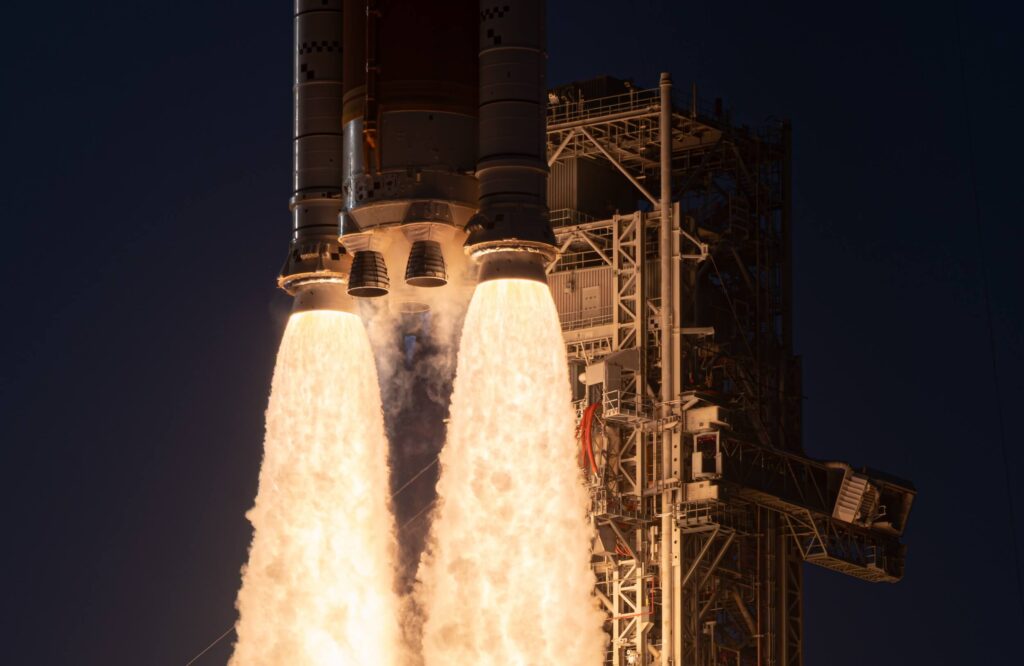
NASA’s Artemis II mission launched on April 1, 2026, sending four astronauts on a 10-day lunar flyby, the first crewed flight beyond low Earth orbit since Apollo 17 in 1972. The mission validated the SLS rocket and Orion spacecraft systems that will underpin an accelerating cadence of lunar missions: Artemis III is planned for 2027 to test commercial lunar landers from SpaceX and Blue Origin in Earth orbit, Artemis IV is targeted for 2028 as the first crewed lunar landing of the program, and NASA has committed to at least one surface landing every year thereafter. As NASA Administrator Jared Isaacman stated at the launch, “Artemis II is the opening act.”
The workforce implications are direct. NASA has issued a workforce directive to rebuild core civil servant engineering competencies and increase in-house development work alongside commercial partners. Boeing, the prime contractor for the SLS core stage, stated that its “workforce and supply chain are prepared to meet the increased production needs” of an accelerated launch schedule, though the company has faced well-publicized production and quality challenges across other programs in recent years. These missions are, in NASA’s words, “critical to an expanding space economy, fueling new industries and technologies, supporting job growth, and furthering the demand for a highly skilled workforce.”
Meanwhile, Boeing’s 2025 Pilot and Technician Outlook projects that the global aviation industry will require nearly 2.4 million new professionals through 2044, including 660,000 pilots, 710,000 maintenance technicians, and 1 million cabin crew members. Two-thirds of that demand is driven by attrition replacement rather than fleet growth. Boeing has responded by expanding workforce training partnerships, including a five-year contract with Trident Technical College in South Carolina to train 787 Dreamliner production and maintenance workers, with Boeing expecting to add 1,000 new jobs at the site over five years.
The global space economy reached $613 billion in 2024, and SpaceX’s pending IPO, targeting a valuation of up to $1.75 trillion, signals that private capital is flowing into space and defense technology at a scale that will sustain workforce demand for years to come.
For workforce planning purposes, the key implication is this: every major segment of the A&D industry (defense manufacturing, commercial aerospace, space, cyber, MRO) is growing simultaneously, and they are all competing for the same finite pool of engineers, machinists, technicians, inspectors, and cleared professionals. The current defense spending acceleration has compressed what would have been a gradual ramp in workforce demand into a more immediate pressure layered on top of existing structural shortages.
The firms competing for workers in 2026 are not only competing with each other, but also with commercial tech, data center construction, and energy for the same skilled trades workers, and with every other defense contractor for the same cleared professionals.

Building Your A&D Workforce Strategy?
Get a clear workforce plan from a staffing partner with 65+ years in aerospace and defense.
11. What A&D Firms Expect Next
4.8% Year-over-year industry revenue growth rate
The aerospace and defense industry enters the second half of 2026 with strong demand and constrained capacity. Revenue continues to grow at approximately 4.8% year over year, yet the talent pipeline cannot keep pace with what the sector needs to deliver.
The AIA/McKinsey 2025 study describes an industry at an inflection point. Companies have invested heavily in attraction and retention through expanded recruiting channels, improved onboarding, and increased wages, but outcomes have not materially improved. Attrition remains near 15%, talent gaps in skilled trades are widening, and the gap between what the industry needs and what the workforce can deliver is growing.
The pivot the industry is making is toward productivity. McKinsey’s conclusion: “The current approaches are no longer feasible. Organizations must figure out how to do more with the workforce they already have, which means retaining that talent they’ve worked so hard to secure, and driving a significant boost in productivity with that talent.”
AI, automation, and digital fluency are now the primary levers. AIA/McKinsey and Deloitte both position AI-driven workforce augmentation as the sector’s most important near-term capability investment. The DoD is positioning AI as foundational across missions including modeling and simulation, operator assistants, and command and control. PwC reports that 57% of A&D executives are using AI-enhanced design and engineering to transform workflows, 16 points higher than the cross-industry average.
Labor dynamics are also influencing M&A. Buyers in A&D transactions are scrutinizing workforce depth, labor stability, and execution maturity during diligence. Sellers are under pressure to demonstrate that growth projections are achievable with the workforce available. In some cases, labor limitations are becoming a valuation issue. Government customers are placing greater emphasis on delivery credibility, and workforce risk is now a factor in contract awards.
The prevailing industry mindset has shifted from aggressive expansion to strategic optimization: finding ways to deliver more with constrained labor resources, invest in the workers already on board, and build flexibility into staffing models that allows firms to respond to program surges without overcommitting to permanent headcount.
It is worth noting that some conditions may ease. Congressional appropriations routinely reshape presidential budget proposals, and the FY2027 $1.5 trillion request may not survive the legislative process at that level. Attrition data from 2024 may not reflect improvements firms have made since. AI adoption could reduce headcount requirements in certain functions faster than current projections suggest. And cyclical softening in commercial aerospace demand, while not currently forecast, would relieve some of the simultaneous pressure on the labor pool. The structural constraints documented in this report, particularly demographics, clearance bottlenecks, and skills misalignment, are unlikely to resolve through any single factor. But the pace and severity of the near-term pressure depend on policy, spending, and technology outcomes that remain uncertain.
12. Future Workforce Outlook (2026 and Beyond)
Aerospace and defense workforce challenges are structural rather than cyclical. Even if hiring slows temporarily in certain segments, labor availability, skills alignment, clearance pipeline constraints, and demographic pressures will continue to shape workforce decisions for years to come.
The numbers tell a consistent story across multiple sources. The AIA/McKinsey 2025 study found that attrition at ~15% is, according to the study’s authors, more than double the cross-industry average, with production-critical roles facing the steepest exits. PwC has projected a retirement-driven gap of millions of workers in the coming years, with an estimated 29% of the workforce over 55 as of 2023. BLS projects aerospace engineer employment to grow 6% from 2024 to 2034, and aerospace technician employment to grow 8%, both above the average for all occupations, driven by satellite demand, drone proliferation, space commercialization, and defense modernization.
Technology is augmenting, not replacing, the A&D workforce. Deloitte’s 2026 outlook describes an industry moving toward AI-driven analytics, autonomous systems, digital twins, and predictive maintenance. These are tools that increase output per worker but simultaneously increase demand for digitally skilled workers who can manage AI-augmented workflows. The majority of task hours in aerospace manufacturing are expected to remain human-driven for the foreseeable future, making workforce planning less about headcount reduction and more about reconfiguring roles for a digital operating environment.
The cleared workforce is a national security asset that cannot be quickly rebuilt. Clearance processing is government-controlled, takes months to years, and is subject to shutdown disruptions and agency capacity constraints. Firms that lose cleared workers lose not just an employee but a capability that may take 12–18 months to replace.
The current defense spending acceleration, driven by Middle East operations, has compressed what would have been a gradual decade-long ramp in defense workforce demand into a more immediate surge on top of existing structural shortages. The FY2027 proposed budget of $1.5 trillion, if enacted at or near that level, signals that defense spending will remain elevated, sustaining workforce pressure across every major A&D segment.
The demand signals extend well beyond defense. The Artemis program’s commitment to annual lunar landings from 2028 onward, combined with SpaceX’s commercial launch cadence, Boeing’s forecast of 2.4 million new aviation professionals needed through 2044, and the Golden Dome program’s requirement for a 30–40% surge in skilled labor, all point in the same direction: the aerospace and defense industry will need more workers, across more skill categories, for a sustained period. And unlike previous defense buildups, today’s expansion is occurring against a backdrop of an aging workforce, constrained clearance pipelines, and competition from commercial technology sectors that did not exist a generation ago.
For firms navigating this environment, the adaptive workforce strategy framework described by Deloitte applies directly:
- Build critical skills internally through apprenticeship, technical training, clearance sponsorship pipelines, and partnerships with technical colleges and K-12 institutions
- Buy specialized expertise through direct hire when specific skillsets or clearance levels are needed immediately
- Borrow flexible labor through contract staffing to manage program-based surges, production ramps, and the gap between contract award and clearance processing completion
No single approach to workforce development will be sufficient. Firms that combine internal development, targeted recruitment, flexible staffing, and proactive clearance pipeline management, while investing in safety, technology, and total compensation, will be better positioned to deliver against program commitments through 2026 and beyond.
What This Means for A&D Leaders
- Plan workforce strategy around total compensation and career development, not wages alone. While compensation is the top reason workers leave, culture, tools, and advancement pathways are what keep them.
- Treat clearance pipeline as a strategic asset: sponsor clearances proactively and don’t wait for program awards to begin the process.
- Track vacancy cost at the program level. AIA/PwC has cited industry estimates of roughly $20,640/month in unrealized revenue per unfilled cleared role, a figure worth monitoring even if directional rather than precise.
- Invest specifically in mid-career retention, as this is the cohort most vulnerable to attrition and most expensive to replace.
- Build early talent pipelines through technical colleges, veterans programs, and K-12 partnerships. The replacement generation takes years, not months, to develop.
- Don’t overlook the supply chain. Small and mid-tier suppliers face the same labor constraints as primes but without the brand recognition or compensation scale to compete for talent.
- Factor workforce depth into M&A diligence and contract bids, since labor availability is now a material risk factor and a determinant of delivery credibility.
- Close the salaried/hourly experience gap. The cultural divide between engineering teams and production workers is a contributing factor in disproportionate turnover on the shop floor.
Related: The State of the U.S. Manufacturing Workforce (2025–2026 Benchmark Report)
Key Takeaways for A&D Leaders
- A&D workforce challenges are structural, not cyclical
- Attrition at ~15% (per AIA/McKinsey) is among the industry’s most pressing operational challenges
- Security clearance constraints create a workforce bottleneck no other industry faces
- Defense spending is at historically elevated levels, but the workforce to execute it has not scaled proportionally
- An aging workforce (29% over 55 as of 2023) will continue driving replacement demand for years
- Technology is reshaping roles, not eliminating the need for skilled workers, and AI augmentation applies primarily to design, planning, and logistics, not hands-on production
- The current defense spending acceleration has compressed a gradual demand ramp into a more immediate pressure
- Adaptive workforce strategies that combine internal development, direct hire, and flexible staffing are increasingly necessary
Learn how Amtec’s aerospace & defense recruitment services can help you navigate these structural labor challenges.
Methodology & Sources
This report consolidates publicly available government data, industry research, and agency reporting to provide a comprehensive view of the U.S. aerospace and defense workforce.
The report was compiled in April 2026 using the latest available data. Industry employment and economic data reflect the 2024 calendar year (AIA/S&P Global, September 2025). BLS occupational wage estimates reflect May 2024 data. Defense budget figures reflect enacted FY2026 appropriations and the FY2027 proposed budget (April 2026). Security clearance data reflect DCSA reporting through early 2026.
Limitations
This report draws on sources with different scopes, methodologies, and reporting periods. AIA industry-level figures encompass the full A&D sector including services and R&D; BLS data primarily reflect NAICS 336400 manufacturing employment. Some figures, particularly from the 2023 AIA/PwC workforce study (70,000+ unfilled cleared roles, 29% over 55), reflect conditions that may have shifted since publication and are noted as such throughout. The $20,640/month vacancy cost estimate is a modeled industry figure, not an observed measurement. BLS occupational wage data reflect May 2024 and may not capture recent market movement driven by defense spending increases. Where survey-based, modeled, or proxy estimates are used, they are identified in context. Primary industry sources, including AIA, McKinsey, PwC, and Deloitte, produce workforce research in connection with their respective membership, consulting, and advisory activities. Readers should evaluate individual data points in the context of their original source, timeframe, and institutional perspective.
Scope
- Industry: U.S. Aerospace & Defense. Federal labor market data primarily reference NAICS 336400 (Aerospace Product and Parts Manufacturing). Industry-level employment, revenue, and workforce composition data encompass the broader A&D sector including services, R&D, IT, and cybersecurity, per AIA definitions.
- Geography: United States
- Workforce: All employees, with emphasis on production, engineering, skilled trades, and security-cleared roles
Primary Sources
U.S. Bureau of Labor Statistics (BLS)
Official U.S. government labor market data used for occupational wages, employment projections, benefits, safety, and productivity metrics.
NAICS 336400 — Aerospace Product and Parts Manufacturing https://www.bls.gov/oes/current/naics4_336400.htm
The following BLS programs and datasets were referenced:
- Occupational Employment and Wage Statistics (OEWS): Occupation-level wage data for NAICS 336400
- Occupational Outlook Handbook (OOH): Aerospace engineer and aerospace technician employment projections, wage data, and growth outlook
- Employer Costs for Employee Compensation (ECEC): Total compensation and benefit cost shares (durable goods manufacturing proxy)
- Survey of Occupational Injuries and Illnesses (SOII / IIF): Nonfatal injury and illness rates
- Productivity and Costs Program: Output per hour, unit labor costs (NAICS 3364)
- Current Population Survey (CPS): Union membership data
Aerospace Industries Association (AIA) / McKinsey & Company
Industry-wide workforce dynamics, attrition data, talent gap analysis, and strategic recommendations drawn from survey data covering 30+ A&D organizations and 600,000+ U.S. employees.
- “Accelerating Progress — Maximizing the Return on Talent in A&D” (June 2025) https://www.aia-aerospace.org/news/aia-and-mckinsey-release-new-study-on-tackling-talent-gaps-in-aerospace-and-defense-industry/
This source was used to inform: industry-wide attrition rates, talent gap analysis by occupation, workforce growth figures, AI/automation priorities, and the productivity imperative framing used throughout the report.
Aerospace Industries Association (AIA) / PwC
Workforce trend analysis, demographic data, cleared role shortages, and employee experience insights.
- “On the Radar: Evolving Workforce and Aerospace and Defense Firm Needs” (May 2023) https://www.aia-aerospace.org/news/workforce-challenges-prove-a-headwind-to-the-growing-aerospace-and-defense-industry/
- “On the Horizon: Workforce Trends in the Aerospace and Defense Industry” (July 2024) https://www.pwc.com/us/en/industries/industrial-products/library/aerospace-defense-workforce-trends.html
These sources were used to inform: unfilled cleared role estimates (70,000+, 2023), aging workforce demographics (29% over 55, 2023), retirement gap projections, salaried/hourly cultural divide analysis, and employee perception data.
Aerospace Industries Association (AIA) / S&P Global Market Intelligence
Annual economic impact data covering employment, GDP contribution, revenue, wages, trade, and subsector composition.
- “2025 Facts & Figures” (September 2025) https://www.aia-aerospace.org/news/american-aerospace-defense-industry-continues-economic-dominance/ https://www.aia-aerospace.org/industry-impact/
This source was used to inform: total industry employment (2.23 million), direct employment (914,000), subsector employment breakdown, $995 billion revenue, average labor income ($115,000), trade surplus ($73.9 billion), and workforce composition by defense/commercial share.
Deloitte Research Center for Energy & Industrials
Forward-looking industry trends, technology adoption, workforce augmentation through AI, and production outlook.
- “2026 Aerospace and Defense Industry Outlook” (December 2025) https://www.deloitte.com/us/en/insights/industry/aerospace-defense/aerospace-and-defense-industry-outlook.html
- “2025 Aerospace and Defense Industry Outlook” (November 2024) https://www.deloitte.com/us/en/insights/industry/aerospace-defense/aerospace-and-defense-industry-outlook/2025.html
These sources were used to frame: AI/agentic AI workforce augmentation (36% of tasks), aging workforce data (25% at/beyond retirement age), commercial aerospace production constraints, defense RDT&E allocation context, technician demand projections (123,000), and the Build, Buy, or Borrow workforce strategy framework.
Defense Counterintelligence and Security Agency (DCSA)
Security clearance processing timelines, investigation backlog data, continuous vetting enrollment, and shutdown impact reporting.
Sources referenced via:
- Federal News Network — DCSA backlog reporting (May 2025)
- Federal News Network — Shutdown impact on clearance processing (October 2025)
- ClearanceJobs — Security clearance timeline guide (2026)
- USFCR — Security clearance levels and processing (March 2026)
U.S. Department of Defense / Congressional Research Service
Defense budget data, spending allocations, and weapon system funding used to contextualize workforce demand.
- FY2026 Defense Budget: Funding for Selected Weapon Systems — Congressional Research Service (R48860, February 2026) https://www.congress.gov/crs-product/R48860
- FY2027 Budget Proposal — reported via NPR, CNN, and France 24 (April 2026)
Additional Sources Referenced
- Aerospace America / AIAA — U.S. aerospace engineering shortage analysis (July 2025), via aerospaceamerica.aiaa.org
- PwC — Aerospace and defense industry performance outlook (June 2025), workforce challenges analysis, and A&D agenda 2026, via pwc.com
- MADICORP — A&D labor shortage analysis and M&A workforce implications (January 2026), via madicorp.com
- Avionics International — Coverage of AIA/PwC 2023 workforce study findings, via aviationtoday.com
- NASA — Artemis II mission updates, Artemis program architecture and workforce directive (2026), via nasa.gov
- Boeing — 2025 Pilot and Technician Outlook; Trident Technical College workforce training partnership (2025), via boeing.com
- Aerospace America / AIAA — Golden Dome workforce requirements and industrial base analysis (2025), via aerospaceamerica.aiaa.org
- CNBC / Reuters — SpaceX/xAI merger and IPO filing details (2026), via cnbc.com
- Defense News — Golden Dome SHIELD contract awards (2025), via defensenews.com
- Federal News Network — Golden Dome FY2027 budget request (2026), via federalnewsnetwork.com
Injury and fatality statistics reflect the most recent finalized SOII and CFOI releases available at the time of compilation.

The Amtec Team
Amtec's editorial team shares hiring strategies, career advice, and workforce insights drawn from 65+ years of staffing experience across aerospace, manufacturing, engineering, and construction.


Our Services
Industries We Serve
Related Posts
View all posts-
EmployersCareer Seekers
Manufacturing Conferences in 2026: Your Complete List
We’ve scoured the web and compiled a list of all manufacturing conferences in 2026 to keep you informed and connected in the industry.
-
Career Seekers
How to Become a CNC Machinist: A Comprehensive Guide
Have a passion for tech and hands-on work? Learning how to become a CNC machinist might be the perfect path to launch your career.
-
EmployersCareer Seekers
Manufacturing Conferences in 2025: Your Complete List
We’ve scoured the web and compiled a list of all manufacturing conferences in 2025 to keep you informed and connected in the industry.